get_site_information_default() {
return (object) [
'url' => WPSEO_Utils::get_home_url(),
'subscriptions' => [],
];
}/**
* Maps the plugin API response.
*
* @param object $site_information Site information as received from the API.
*
* @return stdClass Mapped site information.
*/
protected function map_site_information( $site_information ) {
return (object) [
'url' => $site_information->url,
'subscriptions' => array_map( [ $this, 'map_subscription' ], $site_information->subscriptions ),
];
}/**
* Maps a plugin subscription.
*
* @param object $subscription Subscription information as received from the API.
*
* @return stdClass Mapped subscription.
*/
protected function map_subscription( $subscription ) {
// phpcs:disable WordPress.NamingConventions.ValidVariableName.UsedPropertyNotSnakeCase -- Not our properties.
return (object) [
'renewal_url' => $subscription->renewalUrl,
'expiry_date' => $subscription->expiryDate,
'product' => (object) [
'version' => $subscription->product->version,
'name' => $subscription->product->name,
'slug' => $subscription->product->slug,
'last_updated' => $subscription->product->lastUpdated,
'store_url' => $subscription->product->storeUrl,
// Ternary operator is necessary because download can be undefined.
'download' => ( $subscription->product->download ?? null ),
'changelog' => $subscription->product->changelog,
],
];
// phpcs:enable
}/**
* Retrieves the site information.
*
* @return stdClass The site information.
*/
private function get_site_information() {
if ( ! $this->has_installed_addons() ) {
return $this->get_site_information_default();
}return $this->get_myyoast_site_information();
}/**
* Retrieves the contents for the support section.
*
* @return string The support section content.
*/
protected function get_support_section() {
return '
' . __( 'Need support?', 'wordpress-seo' ) . '
'
. '
'
/* translators: 1: expands to that refers to the help page, 2: closing tag. */
. sprintf( __( 'You can probably find an answer to your question in our %1$shelp center%2$s.', 'wordpress-seo' ), '', '' )
. ' '
/* translators: %s expands to a mailto support link. */
. sprintf( __( 'If you still need support and have an active subscription for this product, please email %s.', 'wordpress-seo' ), 'support@yoast.com' )
. '
';
}
}
get_site_information_default() {
return (object) [
'url' => WPSEO_Utils::get_home_url(),
'subscriptions' => [],
];
}/**
* Maps the plugin API response.
*
* @param object $site_information Site information as received from the API.
*
* @return stdClass Mapped site information.
*/
protected function map_site_information( $site_information ) {
return (object) [
'url' => $site_information->url,
'subscriptions' => array_map( [ $this, 'map_subscription' ], $site_information->subscriptions ),
];
}/**
* Maps a plugin subscription.
*
* @param object $subscription Subscription information as received from the API.
*
* @return stdClass Mapped subscription.
*/
protected function map_subscription( $subscription ) {
// phpcs:disable WordPress.NamingConventions.ValidVariableName.UsedPropertyNotSnakeCase -- Not our properties.
return (object) [
'renewal_url' => $subscription->renewalUrl,
'expiry_date' => $subscription->expiryDate,
'product' => (object) [
'version' => $subscription->product->version,
'name' => $subscription->product->name,
'slug' => $subscription->product->slug,
'last_updated' => $subscription->product->lastUpdated,
'store_url' => $subscription->product->storeUrl,
// Ternary operator is necessary because download can be undefined.
'download' => ( $subscription->product->download ?? null ),
'changelog' => $subscription->product->changelog,
],
];
// phpcs:enable
}/**
* Retrieves the site information.
*
* @return stdClass The site information.
*/
private function get_site_information() {
if ( ! $this->has_installed_addons() ) {
return $this->get_site_information_default();
}return $this->get_myyoast_site_information();
}/**
* Retrieves the contents for the support section.
*
* @return string The support section content.
*/
protected function get_support_section() {
return '
' . __( 'Need support?', 'wordpress-seo' ) . '
'
. '
'
/* translators: 1: expands to that refers to the help page, 2: closing tag. */
. sprintf( __( 'You can probably find an answer to your question in our %1$shelp center%2$s.', 'wordpress-seo' ), '', '' )
. ' '
/* translators: %s expands to a mailto support link. */
. sprintf( __( 'If you still need support and have an active subscription for this product, please email %s.', 'wordpress-seo' ), 'support@yoast.com' )
. '
';
}
}
L’agroécologie assure-t-elle la sécurité alimentaire ? - Action de Carême
Informations sur les options de paiement
Évitez les frais supplémentaires en optant pour le mode de paiement dont les coûts de transaction sont les plus bas. Les coûts varient en fonction du moyen de paiement choisi :
Twint : 1.3%
Facture QR : 0.2%
Mastercard : 1.3%
Google Pay : 3.2%
PostFinance : 2.0%
Visa : 1.3%
PayPal : 3.9%
Apple Pay : 3.2.%
Vous pouvez également prendre en charge les frais qui nous incombent en cliquant à la fin du formulaire de don.
Afrique du Sud, Agroécologie, Éliminer la faim, Transparence
L’agroécologie assure-t-elle la sécurité alimentaire ?
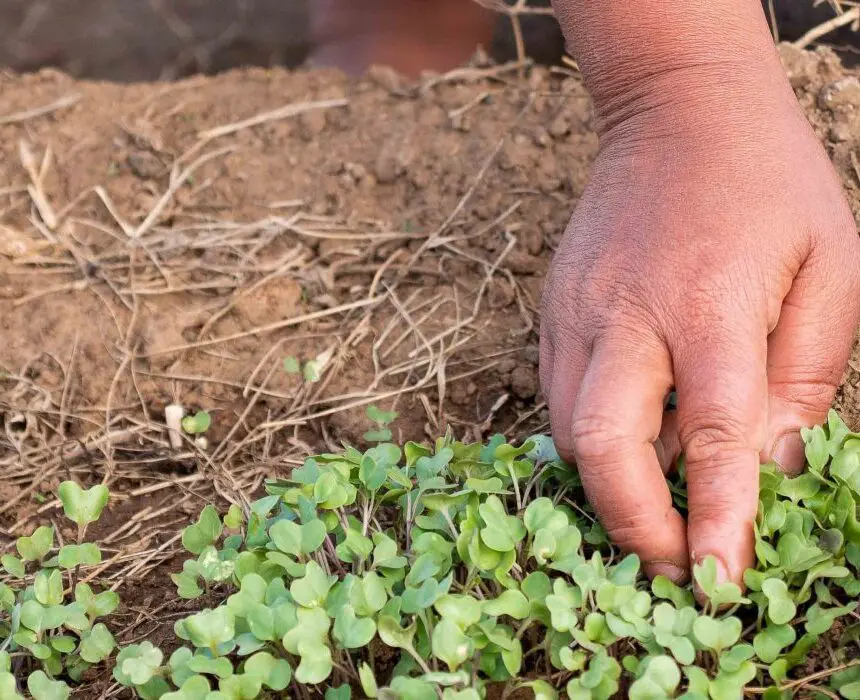
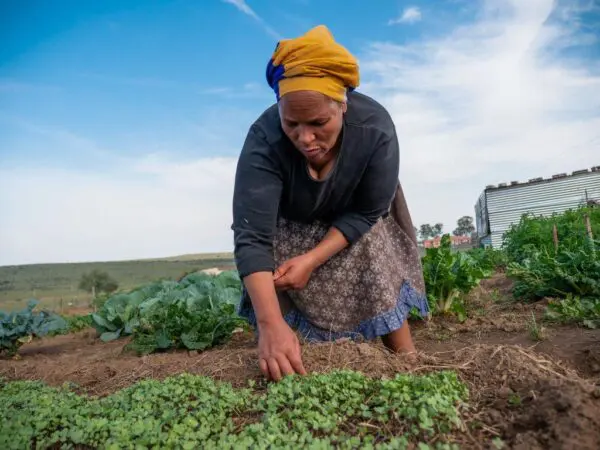
En Afrique du Sud, la politique agricole ne prend pas en compte l’approche agroécologique. Afin de contrer les effets du réchauffement climatique, de nombreuses agricultrices et agriculteurs sud-africains s’engagent donc auprès de réseaux locaux et nationaux. L’agroécologie est-elle la bonne voie vers un modèle agricole socialement équitable et respectueux du climat ? Une étude d’Action de Carême se penche sur cette question. Elle explore comment renforcer les initiatives agroécologiques en Afrique du Sud, ainsi que les moyens d’ancrer une stratégie nationale d’agroécologie dans la politique agricole du pays.
De nombreux réseaux locaux et nationaux d’agricultrices et agriculteurs ainsi que d’organisations non gouvernementales voient dans l’agroécologie une alternative à l’agriculture industrielle : elle met un frein au réchauffement climatique et respecte les droits des familles paysannes. L’étude d’Action de Carême analyse les forces et les faiblesses des efforts en matière d’agroécologie en Afrique du Sud en s’appuyant sur des entretiens et des visites de terrain auprès de 35 organisations et réseaux.
Des défis subsistent
L’étude met en lumière les lacunes dans la mise en œuvre de l’agroécologie en Afrique du Sud. Les initiatives agroécologiques sont encore largement fragmentées, et une compréhension commune de l’agroécologie reste à établir. De plus, la plupart des agricultrices et agriculteurs impliqués cultivent des petites parcelles et des jardins familiaux. En grande partie constituée de femmes âgées, cette population est souvent marginalisée dans la société et fait face à la prédominance de l’agriculture industrielle.
L’agroécologie est une alternative viable
L’étude conclut que les initiatives agroécologiques peuvent servir de baseà des alternatives à l’agriculture industrielle, tout en promouvant le droit à l’alimentation. Afin de favoriser un tel développement de l’agroécologie en Afrique du Sud, il est nécessaire de mettre en place une coordination efficace, de renforcer et de créer des liens entre les différentes initiatives agroécologiques, tout en établissant une stratégie commune pour influencer la politique agricole nationale. Un financement adéquat de la part de l’État est notamment essentiel pour soutenir les initiatives existantes.